A Bastard Mélange: Australian Cuisine and its Odd Multi-Stranded Origins.
As you may have gathered by now, I am Australian. This means a great number of things, but one thing it means is that I’m the inheritor of a tradition of cuisine that’s … odd.
You see, Australian cuisine is essentially, the bastard child of a hundred mothers and fathers. It’s a weird mélange; American fast food, Australian indigenous ingredients, Balkan ragoûts, old bush cookery, Cantonese cookery methods, ingredients, and seasonings, traditional English dishes, Greek dishes, Irish ragoûts, Italian pasta and pizza, Latin American barbecue and bread, Levantine street food and pastries, North African dishes, Polynesian cookery methods, and traditional Scots ragoûts and bread, all welded onto a French-international cuisine chassis. And it’s young; 130 years old, at the most. And you then have to think about it in relation to Australian coffee culture, and Australian wine and spirits, and Australian beer … it’s a whole study, in and of itself.
Today, my featured recipe is an odd one.
I have a perverse fondness for an Australian author, named John O’Grady. I discovered his books when I was around 12 or 13, and I found him absolutely hilarious. He was the kind of author, who I was unable to read on a train, because I would burst out laughing while reading him. LOUDLY. It helped that he lived in Oatley, the Sydney suburb where I spent my first seventeen years, and he wrote about Oatley, and the Georges River, which ran through it, and he wrote in a voice that reminded me of the way my father and his workmates spoke, a way of speaking that you’d occasionaly hear from old blokes at Oatley Pub.
As I grew older, I was able to see John O’Grady better … and it wasn’t good. He was, I suppose, a Leftist, but he was from another era. And because of this, he was vaguely misogynist, and vaguely culturally reactionary (though he was refreshingly anti-racist), and somewhat traditionalist He never reached any great cultural heights, and he was a bit of a dick in general, but he managed to write a few genuinely hilarious books. They’re dated, and politically naïve, and you won’t catch me admiring his cultural views … but I do have a soft spot for his books, perhaps because they remind me of the early Eighties, and of riding around Oatley on my pushbike and fishing in the river, and suchlike.
One of these books is called ‘Survival In The Doghouse’, Ure Smith, Sydney, 1973.
It’s not a great book, It reads like a wannabe cookbook, all hung around a story of three middle-aged, white cishet men, who behave so outrageously that their wives throw them out, and they need to move into an old boatshed, and rough it together there. And between descriptions of O’Grady’s useless mates, and fishing, and his musings on life, there are some recipes.
Some of the recipes are decent. And the prose is hilarious. And the following recipe is included … sort of.
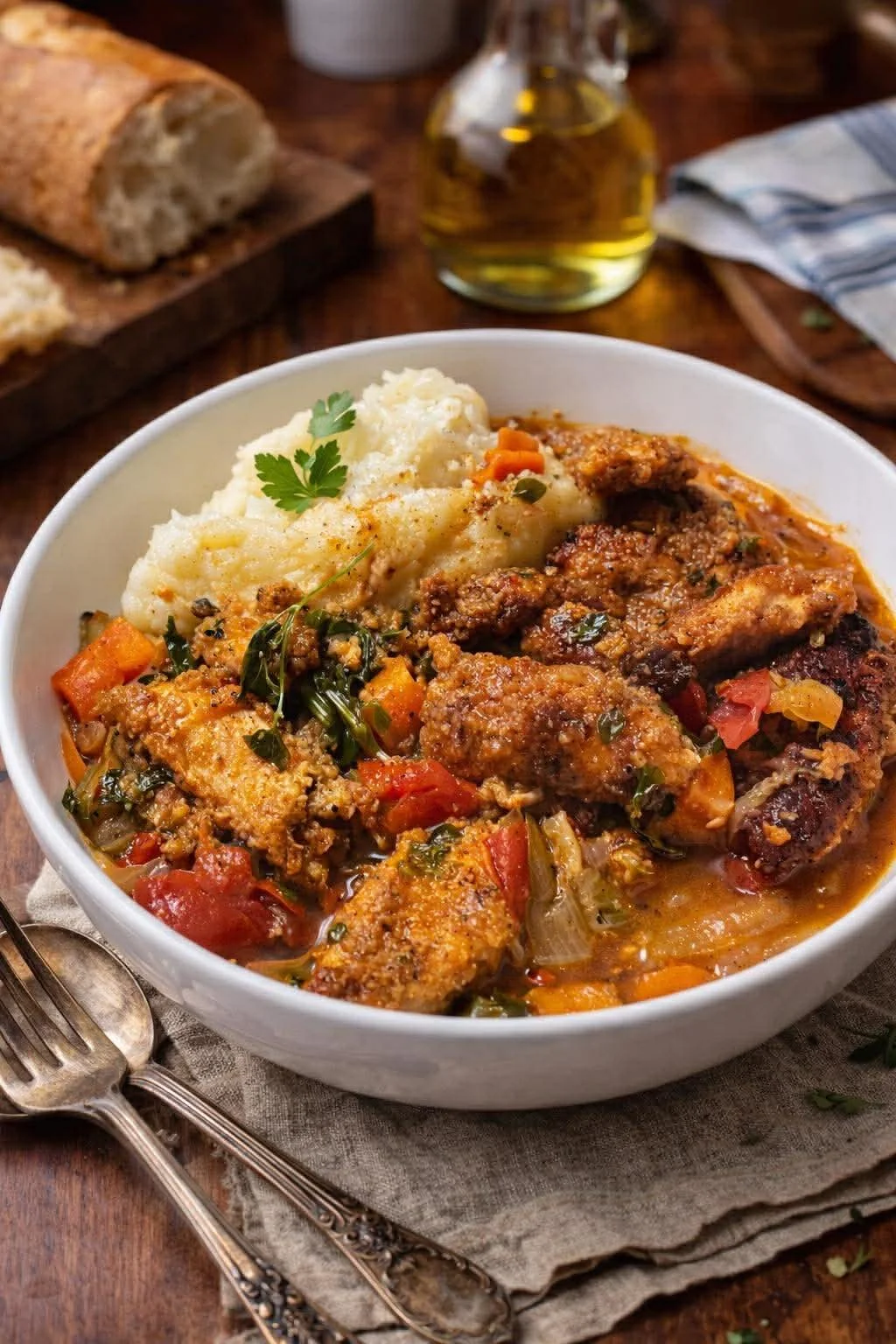
I re-wrote it a bit. The recipe was originally a recipe for cooking mullet. Mullet or Sea mullet (Mugil cephalus) are a very common Australian fish, which almost everybody hates. It’s a very oily, very strong-tasting, very fishy fish. Most people buy them to feed to their cat. But British people often like them, as do many Greeks and Italians; they taste like mackerel or Mediterranean red mullet, Mullus barbatus. However, neither the Possum Bride nor myself are fond of mullet. So, I made the dish with leftover chicken goujons. And it was great! IIt, like Australian cuisine in general, a bit of a hodgepodge; an Italian/Spanish-style ragoût, made with English herbs, and a native Australian fish, served on French-style potato puree.
So, here’s my recipe for …
Soused Chicken
Ingredients
* 1 recipe chicken goujons, 2 large onions, 1 bulb garlic, 2 carrots, 2 celery ribs, 2 large tomatoes, olive oil, salt, pepper, 2 tsp fresh thyme leaves, 1 tsp mixed herbs, 1 tsp MSG, 2 tsp paprika, 400ml chicken stock, 375ml beer or white wine, 4 bay leaves.
Peel the onions, garlic and carrots, crush the garlic and chop the onion and carrots into small pieces. Trim the celery and chop it to the same size as the other vegetables. Put them aside in one bowl. Core the tomatoes and chop them fairly small. Put them aside in another bowl. Gently fry the onion and garlic in some oil until the onion looks transparent. Add the salt, pepper, fresh thyme, mixed herbs, MSG and paprika, mix it up well and let it fry for a further ten minutes. Transfer that lot to a two or three litre casserole dish and add the stock and beer. Put the casserole dish in the oven and bake it at 150ºc (300ºf) for about thirty minutes. Take the casserole dish out of the oven, lay the chicken pieces on top of the vegetables, lay the bay leaves on top of the chicken and return the casserole dish to the oven. Bake it for a further hour. When finished, serve it on mashed potato
Serves four.
The word ‘soused’ is often used to mean ‘pickled’ or ‘brined’. But the etymology is from the Frankish sultja (“saltwater, brine”), related to Old High German sulza (“brine”) and the Proto-Germanic root for salt, sal-. It’s been used to mean everything from ‘soaked’, to ‘simmered’ to ‘marinated’. This dish is a good way to use leftover chicken goujons. It’s really delicate and tastes great. But be warned! Don’t use a bitter variety of beer. It’ll stuff it up.
