The Big Soup - Marsupial Minestrone!
Memory is a funny thing.
When I was a wee bandicoot, Heinz Australia managed to get the actor Robert Morley to be the face of Heinz soup. And they produced a bunch of elaborate and expensive (for the time) TV ads for tinned soup, featuring Robert Morley, talking about the exulted history of the soups that Heinz produced.
One of those ads was for Heinz minestrone. It was all about Mediaeval monks, who invented minestrone, as a way of feeding visiting pilgrims, who would come to the monasteries, seeking food and shelter. And the ad showed robed monks in stone-flagged kitchens, stirring giant cauldrons of rich soup with giant wooden spoons. Now, as a small bandicoot lad, who thrilled to all things Mediaeval, this ad was glorious. And I loved it.
There are one or two teeny, tiny problems with this narrative, however. Number one, Heinz tinned minestrone is a vile, ghastly, mucilaginous goop, composed of reconstituted vegetables, mystery meat, salt, and myriad vegetable gums. Number two, the narrative that Robert Morley presented in his rich, mellifluous tones is utter bollocks.
Minestrone is one of those dishes that many people cook and that almost no-one cooks well. I realise that the preceding might be a little controversial, but hear me out.
But first, some background!
The word minestrone comes from the Italian word minestra (soup) plus the augmentative suffix -one, hence the big soup or the soup with a lot of ingredients.
The old Scotts term for what we call Scotch broth was big broth, with pretty much the same meaning. But I digress.
The word minestra has its root in the Latin word minus or minor or less, which was applied to servants, for obvious reasons. (Bloody Romans!)
Hence, the modern Italian word for soup, minestra originates from the Latin word minestrare, literally that which is served.
Minestrone is an excellent Italian soup. But ignore any idiots who claim to have the ‘real’ recipe for minestrone, there ain’t no such animal. It can contain potato, rice, noodles, beans or polenta, with a huge variety of vegetables. Beef broth, chicken stock, the water left after boiling a ham … the list of possible ingredients is huge! And Italians love arguing over which is more authentic.
The reason minestrone is usually pretty underwhelming is because it contains vegetables that get cooked too long, producing vegetable mush and hydrolysed vegetable proteins. You know that kind of sweet, cloying taste that a lot of vegetable soup gets? That’s the taste of glutamic acid, which is a by-product of hydrolysing vegetable proteins.
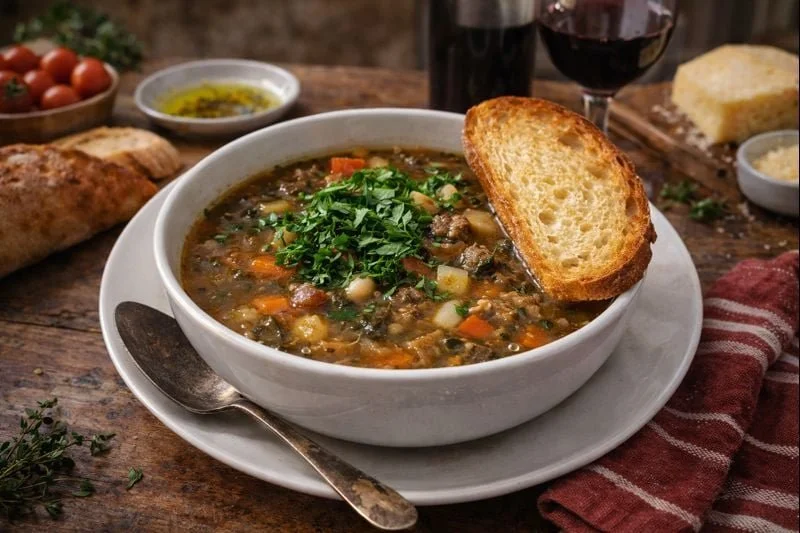
My recipe avoids this problem and produces really rich soup with lightly cooked vegetables. It’s great!
I devised the soup after trying some minestrone in an Italian café in Paris. It was unlike any minestrone I’d ever tasted; the soup was rich and well developed, but the vegetables were only lightly cooked. So I came home and did a heap of experiments, trying to duplicate the soup I’d tasted in France.
Anyhoo, enough talk. Here’s my recipe for …
Minestrone.
Ingredients.
* 250g bacon, guanciale, or pancetta, 12 cloves garlic, olive oil, salt, pepper, cumin, pimentón, tomato paste.
* 400g tin crushed tomatoes, 2l chicken stock, thyme, oregano.
* 2 onions, 2 celery sticks, 2 carrots, ¼ small cabbage, 400g tin borlotti beans,
* Salt, pepper, chopped parsley, grated lemon zest.
Chop the bacon fairly coarsely and peel and crush the garlic. Gently fry them both with some olive oil in a large stewpan, until the bacon starts to look browned and the mixture starts to smell garlicky. Add some salt and pepper, a pinch of cumin and a big pinch of pimentón. Stir the mixture vigorously and keep it frying for a few minutes.
Add a big lump of tomato paste, stir it in and fry the mixture for another five minutes.
Blend the tomatoes to liquid. Plug in the slow-cooker and pour the chicken stock into it. Add the bacon mixture, a lot of thyme and oregano and the blended tomatoes. Cook the soup for a few hours, while you get everything else ready.
Peel the onions and chop them fairly coarsely. Trim the celery and chop it finely. Top and tail the carrots and chop them into small dice. Core the cabbage and shred it finely, picking out any big bits of rib or outer leaf. Put all the vegetables to fry in the same stewpan as you fried the bacon in, stirring them around as they fry, until the cabbage has collapsed somewhat and the onions are cooked through. Add the fried vegetables and the borlotti beans and stir them through and simmer the soup for another hour or so. Adjust the seasonings and put the soup on the table, with the parsley and the lemon.
Serves eight.
Serve it with grated Parmesan and some good bread, or grilled cheese on sourdough toast. Pesto is good too, but if you add the pesto to the soup and cook it for a while, it’s called soupe au pistou. By the by, you can add any leftover cooked meat or vegetables to the soup; just chop or shred them finely.
