You Burnt It Again???
You Burnt It AGAIN???
OK, today I’m talking about Indian food.
In my opinion, Indian cooking ranks as one of the great cuisines of the world, equal to Chinese, French, or Japanese cuisine. And it’s amazingly complex; if you look at curry, (which is not India’s only culinary contribution, but is still a pretty important plank thereof), people often say “I can make this, but it’s not quite like the one I had at X”.
And there’s a reason. Curry falls into two distinct categories; one’s savoury and one’s perfumed. And nobody ever says this! It’s not written in any book. And it’s taken me 25+ years to work it out.
Savoury curry uses cumin, some dhaniya jeera (that’s a mix of cumin and ground coriander), pepper, chilli, turmeric, mustard seed, a little asafoetida, with ghee, onion, garlic, and ginger. The overall effect is loaded with umami, with a rich buttery finish and a lot of back-taste.
Perfumed curry uses a little cumin, a little dhaniya jeera, pepper, a little chilli, turmeric, garam masala, cinnamon, cloves, and fenugreek, with a smaller amount of ghee, a little onion, garlic, and ginger. The overall effect is very perfumed and fragrant, sweet, with a light, almost ethereal finish, very rarely hot, and with a lot of front-taste.
And you could read Indian cookbooks for years and never get this stuff.
This differences are probably a result of the various cultural influences, which India has absorbed; the Achaemenid invasion of the Indus valley, the Anuradhapura invasion of Pandya, the British colonisation, Indo-Greek trading and wars, the Indo-Scythian invasions, the Mongol invasions, the Muslim invasions of the Indian subcontinent, such as the Umayyad campaigns, the invasions of Mahmud Ghazni, sultan of the Ghaznavid Empire, and the invasions of Muhammad of Ghor and Muhammad Bakhtiyar Khaliji, New World foodstuffs, the Persian invasion and Persian trading. All of these incursions and invasions have introduced new cooking techniques, new foodstuffs, and even new religions to the subcontinent.
Now, of course, being Australian, I’ve always had access to pretty good Indian food, Australia being a part of the Commonwealth and all. But others are not so fortunate.
For example, I have several friends who live in the United States. And they find it very hard to get Indian food where they live.
Calamity!
So, for all my Stateside friends, and for everyone else who loves Indian cuisine, I present this recipe for a very good savoury curry.
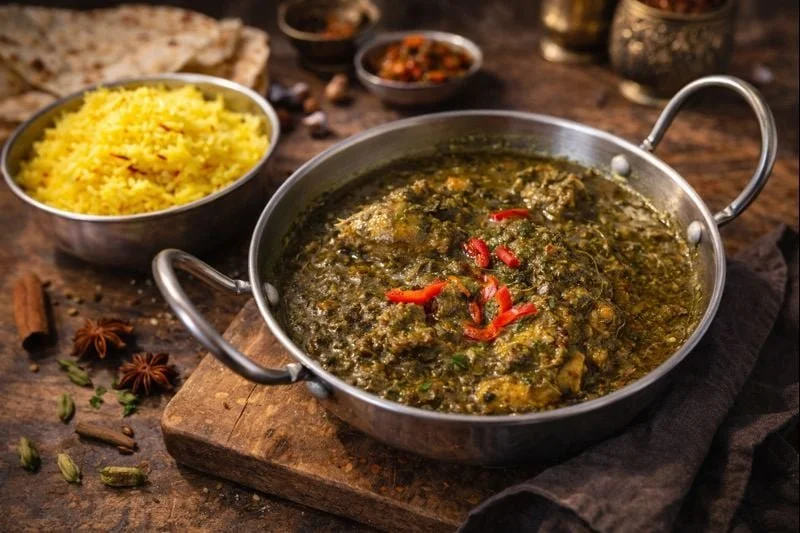
Burnt Green Curry
* 5 cloves of garlic, 2 tsp grated ginger, 3 green chillies, 1 small potato, 1 small bunch spinach, 1 bunch coriander, 1 small onion, 1 tsp kasuri methi or ground fenugreek, ½ tsp cumin seeds, ½ tsp ground cumin, ghee, 2 tsp dhani-jeera powder, ½ tsp turmeric, salt, Canola.
* 500g free-range chicken fillet, 200ml coconut milk, 150ml chicken stock, 4 red chillies, sugar, salt, 1 lime, 12 cherry tomatoes.
First, you have to make the green curry paste. Peel the garlic and ginger, crush the garlic and grate the ginger. Trim the chillies, scrape out the seeds, and roughly chop them. Put all three together in a small bowl. Peel the potato, cut it into little cubes, and put it aside in a small bowl. Wash the spinach, chop it roughly, and put it aside in its own bowl. Pick the leaves off the coriander, discard the stalks, and put the leaves aside in a small bowl.
Fry the kasuri methi or fenugreek, the cumin seeds, and the cumin with a good lump of ghee. Add the ginger-garlic mixture and the green chillies and fry them all together, very gently for fifteen minutes or so. Add the potato and the spinach and gently sauté the mixture until all the liquid is evaporated. By this time, the potatoes should be cooked. If the potatoes are not completely cooked, add a little water and fry the mixture some more until the sauce is dry and the potato pieces are cooked through. Sprinkle the jeera-dhani powder and a little turmeric over the sauce. Add some salt, taste it and add more salt, if it needs it. In a separate pan, heat a little oil and fry the onion in it until the onion is deep gold, with a few brown flecks. Add the onion to the spinach mixture, and fry it for a few more minutes, mixing it well, as it fries. Let the mixture cool and blend or pound the mixture until it is smooth.
Next, you can make the curry. Cut the chicken into curry-sized pieces. Warm half of the coconut milk until it is not-quite boiling. Add the curry paste to the pan and stir it around until the coconut milk is well mixed with the paste. Put the chicken into the liquid, stir it for a couple of minutes and turn the heat down to medium.
Mix the remaining coconut milk with the stock, and add it to the pan a bit at a time, stirring the sauce as you add it. Leave the sauce on a low simmer for twenty minutes. Then add some salt, sugar, and the red chilli. Taste the sauce, adjust the seasonings, and cook the curry for a further few minutes, then switch off the heat.
Grate the zest off the lime and juice it. Cut the cherry tomatoes in quarters and cut out the cores. Add the lime zest and juice, and the cherry tomatoes to the curry. Turn the heat back on and cook the curry for another thirty minutes or so, until the cherry tomatoes soften and melt into the curry.
Serves four.
This dish is great and pretty rare. It’s from the Punjab region, in North India; sometimes it’s called ‘murgh Hariyali, which means ‘chicken greenery’. It’s called ‘burnt’ because you cook the curry paste until it sizzles and dries out. But it’s very good and not very well known. Amaze your guests! But remember; it has absolutely nothing to do with Thai green curry.
