Siberia’s Finest!
Potato goulash is a great dish to cook, when you’re saving money. Along with pelmeni (small, meat-stuffed dumplings, cooked in soup), it is also the national dish of Siberia. And if a dish is popular in Siberia, you can believe that it’s going to be cheap.
In essence goulash (gulyás) is a ragoût, made of meat and vegetables seasoned with paprika Its origins can be traced back to the 10th century CE, to ragoûts eaten by Hungarian shepherds.
At that time, the cooked and flavoured meat was sun-dried and packed into sheep-stomach bags, to be carried out and rehydrated. Earlier versions of goulash did not include paprika, as it was not introduced to Europe until the 16th century.
The name originates from the Hungarian word gulya , which means 'herd of cattle' in Hungarian. So, from that, we get gulyás, which means 'cattle herder' or 'cowboy'.
Over time the dish became gulyáshús ('goulash meat'), i.e. ‘cowboy style ragoût ’.
Goulash is one of those things that isn’t really a dish, well, not a single dish. It’s more like a whole category. In countries like Hungary, the Czech Republic or Romania, the word ‘goulash’ is applied to pretty much any ragoût or ragoût-like dish. It can be anything, from a thick ragoût to a thick soup, to a thin broth, with pieces of meat and vegetables floating in it. Overall, my definition of goulash would be something along the lines of ‘a ragoût of meat, vegetables, or a combination of both, flavoured with paprika’.
But, to me, potato goulash will always remind me of the early 90’s, living with musos and degenerates, eating the cheapest stuff we could find. We lived on Franklin’s meat pies (44c each), Franklin’s instant noodles (18c per packet), and super cheap ragoûts, featuring VERY cheap ingredients. Things like marked down, dented tinned vegetables, barley from a feed store (always marked ‘Not For Human Consumption’), bulk hotdogs, occasional food parcels from our parents, and other very, very inexpensive foods.
And when I discovered potato goulash, I never looked back. This dis is an enormous boon to people with a limited food budget. It tastes great, and it can have almost anything added to it; carrots, cooked sausage, cut up frankfurts or kransky, frozen vegetables, leftover cooked vegetables, leftover cut-up meat, pumpkin, red lentils, sweet potato, tinned beans or chickpeas, or tinned vegetables.
Potato Goulash
Ingredients
* 6 large potatoes, 2 onions, 12 cloves of garlic, oil spray, salt, pepper, olive oil, smoked paprika, MSG, 400g tin tomatoes, 1 chicken stock cube, vinegar, 1 tbsp dried thyme, 1 tbsp dried tarragon.
First, do your prep. Peel the potatoes, cut them into about six pieces each, and put them in a bowl, covered in water. Peel the onions, cut them in half, top to bottom, cut them into smaller pieces; anything from thick slices to tiny dice, and put them aside in a bowl. Peel and crush the garlic, and put them in with the garlic.
Put the potatoes in a bowl, spray them with a little oil and add a lot of salt, pepper, and smoked paprika. Stir them around and rub them with your hands until they are all thoroughly covered on oil. Bake them on an oiled baking dish, until they look golden all over. Put them aside.
Sauté the onions and garlic in some oil until the onion all looks transparent. Add a teaspoon of MSG, the tomatoes, a dash of vinegar, the crumbled stock cube, some salt and pepper, the thyme, the tarragon, a big pinch of paprika. Cook the mixture together for twenty minutes and adjust the seasonings.
Add the potato and stir the pieces in well. Briefly heat the mixture and adjust the seasonings again.
Serves four
This recipe is good for using leftover roast potatoes.
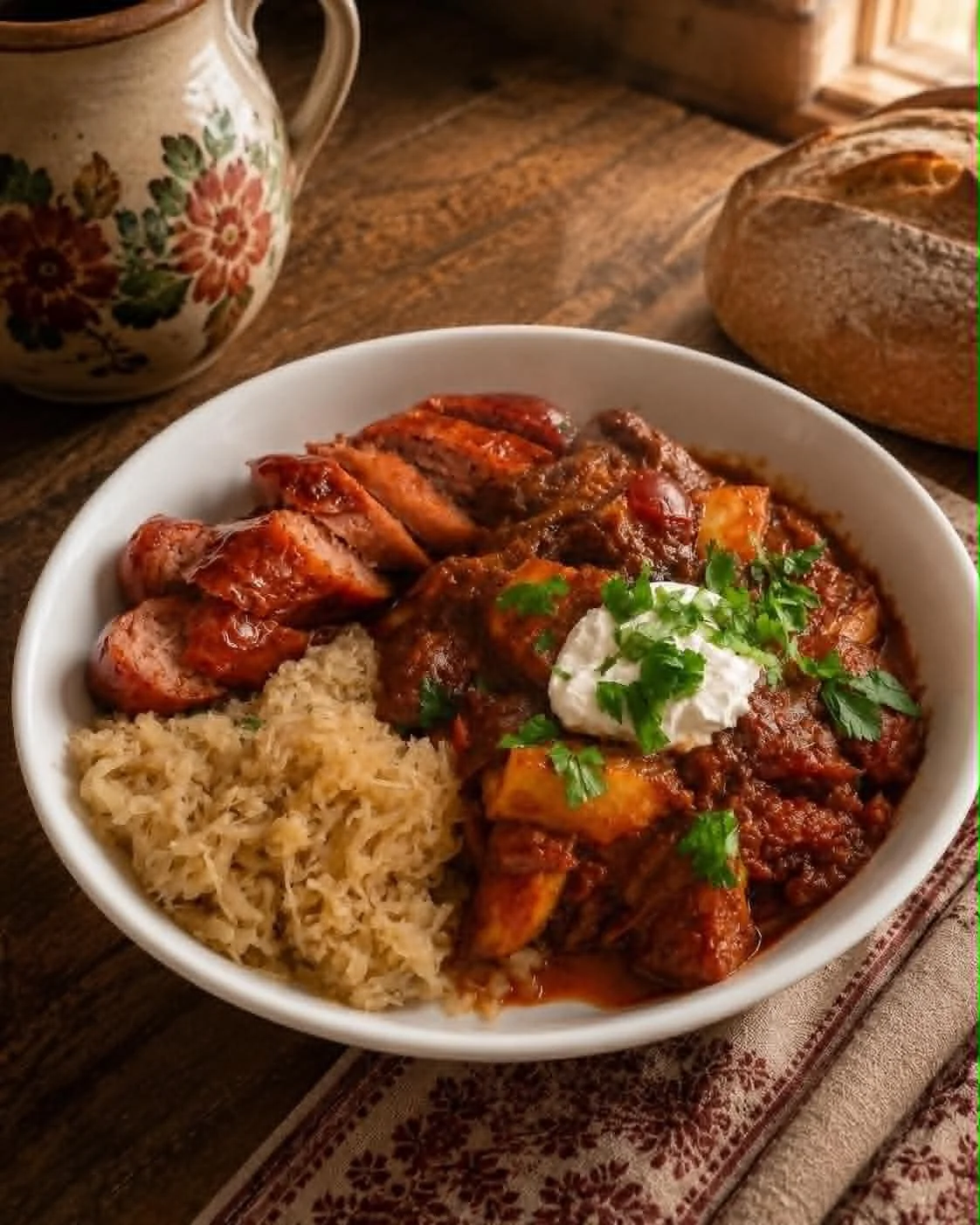
Potato Goulash, with Grilled Kransky and Cabbage
